
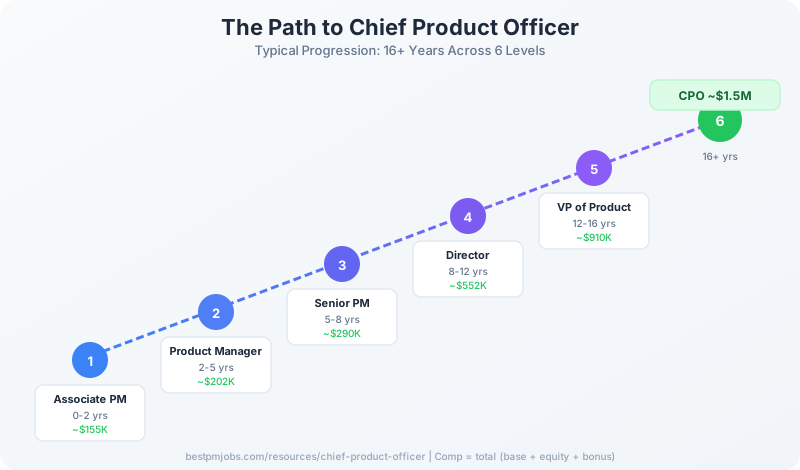
The Path to Chief Product Officer
A typical progression from Associate PM to CPO spans 16 or more years across six levels.
The Chief Product Officer is the most senior product role in most companies. The CPO is accountable for whether the product organization produces business outcomes, not just for whether features ship. That accountability is what separates the role from the VP of Product and what justifies the executive-level compensation described below.
Looking for PM jobs? Browse opportunities on bestpmjobs.com →
CPO Responsibilities
Own product vision and strategy
Set a multi-year product vision aligned to company strategy, choose the few bets that matter, and make sure every product team can trace its work back to that direction.
Lead the product organization
Build and develop the product management, design, and often research functions; hire and coach VPs and directors; and shape the operating model that the product org runs on.
Allocate investment
Decide where product and engineering capacity goes across product lines, balance growth bets against maintenance, and defend the allocation to the executive team and board.
Drive product outcomes
Hold the organization accountable to outcome metrics such as retention, activation, and revenue from product, rather than to a list of shipped features.
Align the executive team
Partner with engineering, marketing, sales, and finance leaders so product strategy, go-to-market, and the financial plan reinforce one another.
Report to the board
Present product strategy, progress, and risks to the board of directors, translating product detail into the business outcomes the board cares about.
CPO vs VP Product vs Head of Product
| Aspect | CPO | VP of Product | Head of Product |
|---|---|---|---|
| Scope | All products, company-level | The product function or a major line | Product at a smaller company or business unit |
| Reports to | CEO and board | CPO or CEO | CEO or founder |
| Main focus | Strategy and investment across products | Execution of strategy within the function | Owning all of product where no CPO exists |
| Typical total comp | ~$1.5M (mid) | ~$910K (mid) | Varies; often VP-equivalent |
Learn more about the adjacent roles in the Head of Product guide and the Director of Product Management guide, or see the full ladder in PM career levels.
Aiming for the Executive Track?
Senior and leadership product roles open the path toward CPO. Browse current openings.
Find PM Jobs3,591+ active PM roles · $150K+ average salary
CPO Compensation
In 2026, CPO total compensation in the United States ranges from about $930,000 to $3.8 million, with a national midpoint near $1.5 million. At the midpoint, the package splits into base salary, annual equity value, and a cash bonus as shown below. Equity is the largest and most variable piece, which is why totals at venture-backed and large public companies reach the top of the range.
| Component | Amount (mid) | Share of total | Notes |
|---|---|---|---|
| Base salary | $500,000 | 33% | Cash, paid through the year; the most stable component. |
| Equity (annual value) | $775,000 | 52% | Stock or options; the largest and most variable component. |
| Cash bonus | $225,000 | 15% | Tied to company and product performance targets. |
| Total (mid) | $1,500,000 | 100% | Range: $930K to $3.8M |
Equity drives the spread
Path to CPO
Most CPOs reach the role after 16 or more years in product, progressing through six levels. The years below are typical, not guaranteed; some leaders move faster, and some enter from a successful founder or general manager role.
Associate PM
0 to 2 years~$155K totalLearn the craft; own a feature area under guidance.
Product Manager
2 to 5 years~$202K totalOwn a product area end to end and ship measurable outcomes.
Senior PM
5 to 8 years~$290K totalOwn a major product line and influence beyond your team.
Director of Product
8 to 12 years~$552K totalManage PMs, own a product portfolio, and set local strategy.
VP of Product
12 to 16 years~$910K totalRun the product function and partner with the executive team.
Chief Product Officer
16+ years~$1.5M totalOwn company-level product strategy and report to the board.
Required Skills
Product strategy
Choose where to compete and how to win at the company level.
Executive communication
Translate product detail into board-level business outcomes.
Organizational leadership
Hire, develop, and retain product leaders and teams.
Commercial fluency
Connect product bets to revenue, margin, and the financial plan.
Cross-functional alignment
Unite engineering, design, marketing, and sales on one direction.
Outcome accountability
Hold the org to retention, activation, and revenue, not feature lists.
How Companies Hire a CPO
Hiring a CPO usually takes 3 to 6 months and runs through these steps. The long timeline reflects the cost of an executive mis-hire, not a shortage of candidates.
Define the mandate
Write the CPO charter: the company-level outcomes the role owns and how success is measured in 12 to 18 months.
Run a retained search
Engage an executive search firm to reach senior product leaders who are not actively looking.
Interview against strategy
Test candidates on company-level strategy, leadership scenarios, and board communication, not feature execution.
Check executive references
Speak with former CEOs and direct reports to confirm strategy, leadership, and outcomes.
Structure the offer
Build a package weighted toward equity, with base near $500K and bonus tied to product and company performance.
The same rigor applies further down the ladder. See how to hire a product manager for the equivalent process at the individual-contributor and management levels.
Frequently Asked Questions
What is a Chief Product Officer (CPO)?
A Chief Product Officer (CPO) is the senior executive accountable for a company's product vision, strategy, and the performance of the entire product organization. The CPO sits on the executive team, usually reporting to the CEO, and translates business goals into a product strategy that engineering, design, and product management execute. Unlike a VP of Product who runs a function, the CPO sets company-level product direction and owns product outcomes at the board level.
How much does a Chief Product Officer make?
In 2026, total compensation for a CPO in the United States ranges from about $930,000 to $3.8 million, with a national midpoint near $1.5 million. The midpoint typically splits into roughly $500,000 base salary, about $775,000 in equity value, and about $225,000 in cash bonus. Base salary alone has a midpoint near $500,000. Equity is the largest and most variable component, so totals at venture-backed companies and large public firms reach the top of the range.
What is the difference between a CPO and a VP of Product?
A CPO is a company-level executive who owns product vision, strategy, and the entire product organization, and who reports to the CEO with a board-facing remit. A VP of Product runs the product management function or a major product line, reporting to the CPO or CEO. The CPO sets direction across all products; the VP executes within that direction. Smaller companies may have a VP of Product as the top product role until they scale enough to justify a CPO.
How do you become a Chief Product Officer?
Most CPOs reach the role after 12 to 20 years in product, progressing through Associate PM, PM, Senior PM, Director, and VP of Product before the CPO seat. The path requires a track record of shipping products that moved business outcomes, experience managing managers, and demonstrated executive influence with the CEO, board, and go-to-market leaders. Some CPOs enter from adjacent senior roles such as a successful founder or a general manager with strong product ownership.
What skills does a CPO need?
A CPO needs product strategy, executive communication, organizational leadership, commercial and financial fluency, and the ability to align engineering, design, marketing, and sales around a shared product vision. The job is less about hands-on feature work and more about setting direction, building and developing product leaders, allocating investment, and reporting product outcomes to the board. Strong CPOs pair customer insight with business judgment so product bets serve company strategy.
Does every company need a CPO?
No. Early-stage startups usually have a founder or a VP of Product owning product, and they add a CPO only when the product organization grows large enough that company-level product strategy needs a dedicated executive. A CPO becomes valuable when there are multiple product lines, several product teams to align, or a board that wants product outcomes owned at the executive level. Adding the role too early creates an extra layer without a clear mandate.
Who does a CPO report to?
A CPO almost always reports to the CEO and sits on the executive leadership team alongside the CFO, CTO, and CRO or CMO. In some companies the CPO and CTO responsibilities are combined into a single Chief Product and Technology Officer. The CPO regularly presents product strategy and outcomes to the board of directors, which is one of the features that distinguishes the role from a VP of Product.
How long does it take to hire a CPO?
Hiring a CPO typically takes 3 to 6 months because the search is executive-level and the candidate pool is small. Companies usually run a retained executive search, define the mandate and success measures up front, interview a short slate against company-level strategy and leadership scenarios, and check references with former CEOs and direct reports. The long timeline reflects the cost of a mis-hire at the executive level rather than a lack of candidates.
About the Author

Aditi Chaturvedi
·Founder, Best PM JobsAditi is the founder of Best PM Jobs, helping product managers find their dream roles at top tech companies. With experience in product management and recruiting, she creates resources to help PMs level up their careers.