
The Short Answer
The RICE framework prioritizes features by scoring each one as (Reach × Impact × Confidence) ÷ Effort, giving you one number to compare opportunities objectively.
Developed by Intercom, RICE turns four estimates — Reach (users affected per quarter), Impact (0.25–3 scale), Confidence (50%–100%), and Effort (person-months) — into a single comparable score, removing bias and politics from prioritization. Higher scores mean higher priority.
Key Takeaways
| Detail | At a Glance | Notes |
|---|---|---|
| Formula | (Reach × Impact × Confidence) ÷ Effort | Higher score = higher priority |
| What it solves | Objective feature prioritization | Removes bias and politics from decisions |
| Best for | Comparing medium-term initiatives | Features, improvements, and experiments with some data |
| Score scale | Impact 0.25–3, Confidence 50%–100% | Reach in users/quarter, Effort in person-months |
| Created by | Intercom | Now used by Atlassian and leading product teams |
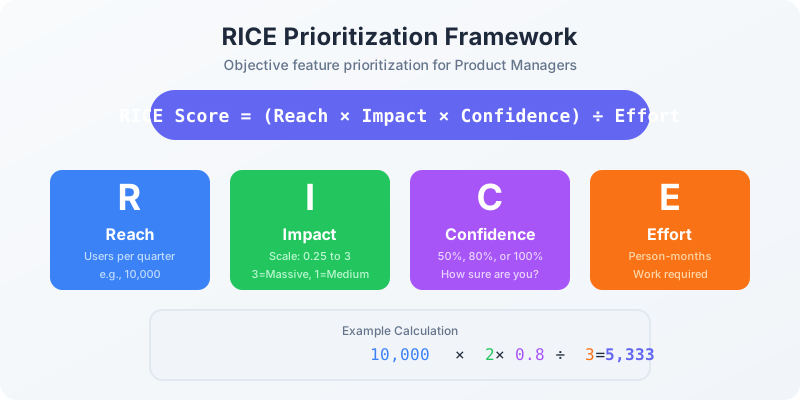
RICE Prioritization Framework - Visual Guide
The RICE framework helps Product Managers objectively prioritize features by scoring Reach, Impact, Confidence, and Effort.
The RICE Formula
Reach
Users impacted per quarter
10,000
Impact
0.25 to 3 scale
2 (High)
Confidence
50% to 100%
80%
Effort
Person-months
3
Example Calculation
Why Use RICE?
Every PM faces the same challenge: too many good ideas, not enough resources. Stakeholders push their priorities, engineers have opinions, and without a framework, the loudest voice wins. RICE provides an objective way to compare opportunities and make defensible decisions.
Developed by Intercom, RICE forces you to think through four critical dimensions of any initiative. The resulting score gives you a single number to compare features—removing bias and politics from prioritization. When someone asks "why did we prioritize X over Y?" you have a clear, data-backed answer.
RICE works best for comparing medium-term initiatives (features, improvements, experiments) where you have some data to inform estimates. It's not meant for critical bugs, strategic bets, or urgent opportunities—those require different decision frameworks.
The Four Components of RICE
Reach
How many users will this impact in a given time period?
How to measure:
Number of users per quarter
Examples:
All visitors see the homepage
Only 5% of users would use this
New signups per quarter
Tips:
- Use product analytics for accuracy
- Be consistent across all features
- Specify the time period (usually quarterly)
- For new features, estimate conservatively
Impact
How much will this affect each user who encounters it?
How to measure:
Scale: 3 = Massive, 2 = High, 1 = Medium, 0.5 = Low, 0.25 = Minimal
Examples:
Dramatically changes daily work
Significant value for users who need it
Nice improvement, not life-changing
Tips:
- Most features are 0.5-1 impact—be honest
- Consider impact on your north star metric
- Ask: "Would users notice if we removed this?"
- Reserve 3 for truly transformative features
Confidence
How confident are you in your Reach and Impact estimates?
How to measure:
Percentage: 100%, 80%, or 50%
Examples:
We have direct evidence
Good data, some assumptions
Limited data, significant uncertainty
Tips:
- Be honest—overconfidence skews results
- Low confidence = opportunity for research
- Document what would increase confidence
- Consider running experiments first
Effort
How much work is required to ship this?
How to measure:
Person-months of work
Examples:
2-3 days total work
Design + eng + QA over 6 weeks
Major multi-quarter initiative
Tips:
- Include all roles: design, eng, QA, etc.
- Get estimates from the team, don't guess
- Round to standard increments (0.5, 1, 2, 3...)
- Higher effort isn't bad—just factor it in
RICE Scoring Examples
Here's how five different features compare using RICE scoring. Notice how the framework surfaces quick wins and deprioritizes low-confidence ideas.
| Feature | Reach | Impact | Confidence | Effort | RICE Score |
|---|---|---|---|---|---|
Mobile app push notifications Good reach, medium impact, low effort—quick win | 40,000 | 1 | 80% | 1 | 32,000 |
Checkout page redesign High reach (all purchasers), high impact on conversion, good confidence from user research | 50,000 | 2 | 80% | 3 | 26,667 |
Dark mode High reach but low impact (nice-to-have), medium effort | 80,000 | 0.5 | 80% | 2 | 16,000 |
Smart recommendations High potential but low confidence—consider running an experiment first | 60,000 | 2 | 50% | 4 | 15,000 |
API v2 migration Low reach (only developers), clear scope, high effort | 5,000 | 1 | 100% | 6 | 833 |
Key Insights
- • Push notifications wins due to low effort (quick win)
- • Checkout redesign is high priority despite significant effort
- • Smart recommendations drops due to low confidence—run an experiment first
- • API migration scores lowest—limited reach reduces priority
How to Run a RICE Scoring Session
List your candidates
Gather all features, improvements, and ideas you're considering. Include items from stakeholder requests, user feedback, and team ideas. Don't filter yet—get everything on the table.
Estimate Reach first
Use product analytics to estimate users affected per quarter. For new features, look at similar features or user research. Be specific and document your assumptions.
Score Impact honestly
Ask: "How much will this move our north star metric?" Most features are 0.5-1. Reserve 2-3 for truly significant changes. Be conservative— overestimating impact is the most common RICE mistake.
Assess Confidence
Be honest about uncertainty. Low confidence isn't bad—it signals where you need more data. Consider running experiments on low-confidence, high-potential ideas before committing resources.
Get Effort from the team
Don't guess effort—ask engineering, design, and QA. Use person-months and include all work required. It's okay to be approximate; the goal is relative comparison, not perfect estimates.
Calculate, sort, and discuss
Calculate RICE scores and rank features. Use scores as a starting point for discussion, not the final answer. Consider dependencies, strategic fit, and other factors that RICE doesn't capture.
Common RICE Mistakes
Mistakes to Avoid
- -Inflating Impact scores to get features prioritized
- -Using 100% Confidence without strong data
- -Guessing Effort instead of asking the team
- -Treating RICE scores as absolute truth
- -Comparing features with different time horizons
Best Practices
- +Document assumptions for each estimate
- +Use consistent measurement periods (quarterly)
- +Recalibrate regularly based on actual results
- +Use scores for discussion, not dictation
- +Consider running experiments for low-confidence items
When to Use (and Not Use) RICE
Use RICE For:
- Comparing multiple feature ideas
- Quarterly/sprint planning
- Justifying prioritization decisions
- Identifying quick wins
- Deprioritizing pet projects objectively
Don't Use RICE For:
- Critical bugs (just fix them)
- Strategic bets (use different criteria)
- Time-sensitive opportunities
- Technical debt (impact is hidden)
- Compliance/legal requirements
Frequently Asked Questions
What is the RICE prioritization framework?
RICE is a prioritization framework developed by Intercom that scores features based on four factors: Reach (how many users will be affected), Impact (how much will it affect them), Confidence (how sure are you about estimates), and Effort (how much work is required). The RICE score = (Reach × Impact × Confidence) / Effort. Higher scores indicate higher priority.
How do you calculate a RICE score?
RICE Score = (Reach × Impact × Confidence) / Effort. For example: Reach = 10,000 users/quarter, Impact = 2 (high), Confidence = 80%, Effort = 3 person-months. Score = (10,000 × 2 × 0.8) / 3 = 5,333. Compare scores across features to prioritize objectively.
What are good Impact scores in RICE?
Impact is scored on a 0.25-3 scale: 3 = Massive impact (dramatically changes behavior), 2 = High impact (significant improvement), 1 = Medium impact (noticeable improvement), 0.5 = Low impact (minor improvement), 0.25 = Minimal impact (barely noticeable). Be conservative—most features are 0.5-1 impact.
How do you estimate Reach in RICE?
Reach is the number of users affected within a time period (usually per quarter). Use product analytics to estimate: total users × percentage who use the affected feature. For new features, estimate based on similar features or user research. Be specific and consistent across all features being compared.
What Confidence percentage should I use?
Confidence reflects certainty in your estimates: 100% = High confidence (solid data, clear requirements), 80% = Medium confidence (some data, reasonable assumptions), 50% = Low confidence (limited data, significant assumptions). Use 50% for gut feelings, 80% for educated estimates with some data, 100% only when you have strong evidence.
How do you measure Effort in RICE?
Effort is measured in person-months (or person-weeks for smaller teams). Include design, engineering, QA, and any other work required. Get estimates from your team—don't guess. The goal is relative comparison, so consistency matters more than precision. Round to 0.5, 1, 2, 3, 5, etc.
When should I NOT use RICE?
RICE works best for comparing medium-term feature investments. Don't use it for: critical bug fixes (just fix them), strategic initiatives (use different criteria), time-sensitive opportunities (speed matters more), or technical debt (has hidden impact). RICE is a tool, not a replacement for judgment.
How does RICE compare to other prioritization frameworks?
RICE is more quantitative than MoSCoW or Kano, making it better for comparing many options. Unlike ICE (which is simpler), RICE separates reach from impact and includes confidence. WSJF (SAFe) is similar but uses different factors. Choose RICE when you want rigorous comparison across many features with clear metrics.
About the Author

Aditi Chaturvedi
·Founder, Best PM JobsAditi is the founder of Best PM Jobs, helping product managers find their dream roles at top tech companies. With experience in product management and recruiting, she creates resources to help PMs level up their careers.