
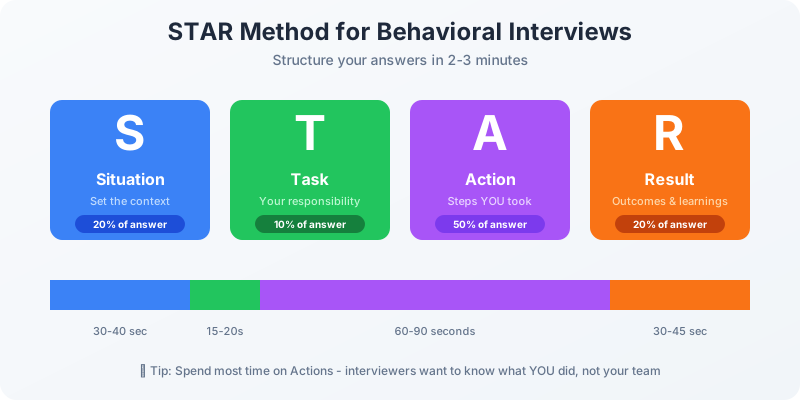
STAR Method for Behavioral Interviews
Structure your behavioral interview answers using the STAR format for clear, compelling responses that highlight your individual contributions.
Situation
Set the context
20% of answerTask
Your responsibility
10% of answerAction
Steps YOU took
50% of answerResult
Outcomes & learnings
20% of answerAnswer Time Allocation (2-3 minutes total)
The STAR Method
STAR is a structured interview response framework that stands for Situation, Task, Action, and Result. It helps you give complete, organized answers to behavioral questions by walking through the context, your responsibility, the specific steps you took, and the outcomes achieved. Every behavioral answer should follow this structure to clearly demonstrate your competencies.
Situation
Set the context briefly. Where were you? What was happening? (2-3 sentences)
~20% of answer
Task
Your specific responsibility or goal. What were YOU accountable for?
~10% of answer
Action
The specific steps YOU took. Be detailed—this is the most important part.
~50% of answer
Result
Quantifiable outcomes and learnings. What was the impact? What did you learn?
~20% of answer
Sample STAR Answer
Question:
Tell me about a time you had to influence without authority.
Situation
At my previous company, I identified that our checkout flow had a 40% drop-off rate at the payment step. I needed to convince engineering leadership to prioritize a redesign, but they were focused on a major platform migration.
Task
My goal was to get engineering resources allocated to improve checkout conversion, even though it wasn't on the roadmap.
Action
First, I quantified the business impact: the 40% drop-off was costing us approximately $500K in monthly revenue. I created a compelling one-pager with data visualization showing the trend over time. Then I scheduled 1:1s with the engineering director and lead architect to understand their concerns—they worried about destabilizing the payment system during migration. I proposed a phased approach: quick UI wins that didn't touch backend, followed by deeper changes post-migration. I also offered to take on some of their documentation burden to free up bandwidth. Finally, I presented the proposal at the leadership meeting with ROI projections.
Result
The engineering team agreed to allocate one engineer for "low-risk" UI improvements. Those changes alone improved conversion by 8%, generating approximately $100K in monthly revenue. This built trust, and post-migration, we got full support for the complete redesign, ultimately achieving a 22% conversion improvement. I learned that understanding others' constraints and finding creative compromises is more effective than pushing your agenda.
Why this works: Specific numbers ($500K, 40%, 8%), clear actions (1:1s, one-pager, phased approach), shows empathy for engineering constraints, and includes a learning takeaway.
Questions by Competency
Leadership & Influence
6 questionsDemonstrate how you lead without formal authority
Tell me about a time you had to influence without authority.
Tip: Focus on how you built alignment through data, relationships, and communication.
Describe a situation where you led a team through a difficult challenge.
Tip: Emphasize your leadership style and how you kept the team motivated.
Tell me about a time you had to make an unpopular decision.
Tip: Show how you communicated the decision and managed stakeholder concerns.
How have you motivated a team that was struggling?
Tip: Discuss diagnosing the problem and the specific actions you took.
Describe a time you championed a new idea or process.
Tip: Highlight how you built buy-in and overcame resistance.
Tell me about a time you had to lead a project with unclear requirements.
Tip: Show how you created clarity and moved forward despite ambiguity.
Collaboration & Communication
6 questionsWorking effectively with cross-functional teams
Tell me about a time you had a conflict with an engineer/designer/stakeholder.
Tip: Focus on understanding their perspective and finding resolution.
Describe how you worked with a difficult stakeholder.
Tip: Show empathy for their position while achieving your goals.
How have you handled disagreements about product direction?
Tip: Emphasize data, customer insights, and how you reached alignment.
Tell me about a time you had to say "no" to a stakeholder.
Tip: Demonstrate how you delivered the message constructively.
Describe a successful cross-functional project you led.
Tip: Highlight coordination, communication, and relationship building.
How do you communicate technical concepts to non-technical stakeholders?
Tip: Give specific examples of adapting your message to your audience.
Customer Focus
6 questionsUnderstanding and advocating for user needs
Tell me about a time you went above and beyond for a customer.
Tip: Show genuine empathy and the impact of your actions.
Describe how you incorporated customer feedback into a product decision.
Tip: Demonstrate your research process and how it influenced outcomes.
Tell me about a time you had to balance customer needs with business needs.
Tip: Show how you found a solution that addressed both.
How have you advocated for users when stakeholders pushed back?
Tip: Emphasize using data and research to make your case.
Describe a time you discovered an unmet customer need.
Tip: Highlight your discovery process and what you did with the insight.
Tell me about a product decision you made based on customer research.
Tip: Connect specific research findings to your decision.
Data-Driven Decision Making
6 questionsUsing metrics and analysis to drive decisions
Tell me about a time you used data to change a product decision.
Tip: Show your analysis process and how data shifted the direction.
Describe a situation where you had to make a decision with incomplete data.
Tip: Explain your reasoning and how you mitigated risk.
How have you defined and tracked success metrics for a feature?
Tip: Walk through your metric selection process and monitoring approach.
Tell me about an A/B test that surprised you.
Tip: Show curiosity about the unexpected result and what you learned.
Describe how you prioritized features using data.
Tip: Explain your framework and the data inputs you used.
Tell me about a time you challenged an assumption with data.
Tip: Show how you identified the assumption and gathered evidence.
Problem Solving & Execution
6 questionsTackling challenges and delivering results
Tell me about the most complex problem you've solved.
Tip: Break down your approach and highlight creative thinking.
Describe a time you had to meet an aggressive deadline.
Tip: Show how you prioritized and what tradeoffs you made.
Tell me about a project that didn't go as planned.
Tip: Focus on how you adapted and what you delivered despite setbacks.
How have you handled scope creep on a project?
Tip: Demonstrate assertiveness in managing scope while staying collaborative.
Describe a time you had to pivot a product strategy.
Tip: Explain what triggered the pivot and how you managed the transition.
Tell me about a time you simplified a complex process.
Tip: Show your analytical approach to identifying inefficiencies.
Failure & Growth
6 questionsLearning from mistakes and showing resilience
Tell me about your biggest professional failure.
Tip: Be genuine, take accountability, and emphasize learning.
Describe a product you launched that didn't meet expectations.
Tip: Focus on what you learned and how you'd approach it differently.
Tell me about a time you received critical feedback.
Tip: Show how you processed it and what changes you made.
Describe a mistake you made and how you handled it.
Tip: Demonstrate accountability and your recovery process.
Tell me about a time you had to admit you were wrong.
Tip: Show intellectual humility and how you corrected course.
How have you grown as a PM in the last year?
Tip: Be specific about skills developed and how you developed them.
Preparation Tips
Do This
- +Write out your STAR stories in advance
- +Practice saying them out loud (time yourself)
- +Use specific numbers and outcomes
- +Focus on YOUR actions, not the team's
- +Include what you learned, especially from failures
- +Prepare stories that can flex to multiple questions
Avoid This
- -Vague answers without specific examples
- -Taking credit for team accomplishments
- -Blaming others for failures
- -Rambling past 3 minutes
- -Using the exact same story twice
- -Fake "failures" that are actually humble brags
Story Preparation Template
Use this template to prepare your 5-7 core STAR stories. Each story should be adaptable to multiple question types.
Story Title:
Give it a memorable name (e.g., "Checkout Redesign," "Difficult Stakeholder")
Competencies Covered:
List 2-3 competencies this story demonstrates (e.g., Leadership, Data-Driven, Conflict)
Situation (2-3 sentences):
Context: company, team, project, timeframe, challenge
Task (1-2 sentences):
Your specific responsibility or goal
Actions (bullet points):
3-5 specific steps YOU took. Be detailed.
Results (with numbers):
Quantifiable outcomes + what you learned
Frequently Asked Questions
What is the STAR method for behavioral interviews?
STAR stands for Situation, Task, Action, Result. It's a structured way to answer behavioral questions: describe the Situation (context), your specific Task (responsibility), the Actions you took (focus here), and the Results achieved (quantify when possible). This framework helps you give complete, organized answers that clearly demonstrate your competencies.
How many STAR stories should I prepare?
Prepare 5-7 versatile STAR stories that cover key PM competencies: leadership, collaboration, conflict resolution, data-driven decisions, customer focus, and handling failure. Each story should be adaptable to multiple question types. For example, a story about launching a feature can demonstrate leadership, cross-functional collaboration, and results orientation.
How long should a behavioral interview answer be?
Aim for 2-3 minutes per answer. Spend about 20% on Situation/Task (30-40 seconds), 50% on Action (60-90 seconds), and 30% on Result (30-45 seconds). If the interviewer wants more detail, they'll ask follow-up questions. Avoid rambling—concise, specific answers are more impactful than lengthy ones.
What if I don't have PM experience for behavioral questions?
Draw from any professional experience where you demonstrated PM-relevant skills: leading projects, working with stakeholders, making data-driven decisions, or solving customer problems. Stories from engineering, consulting, marketing, or even academic projects can work. Focus on transferable skills and your role in driving outcomes.
Should I use the same story for multiple questions?
You can reference the same project but highlight different aspects. For a "conflict" question, focus on the disagreement and resolution. For a "leadership" question from the same project, emphasize how you rallied the team. However, avoid telling the exact same story twice in one interview loop—prepare enough stories for variety.
How do Amazon Leadership Principles affect behavioral interviews?
Amazon explicitly evaluates candidates against 16 Leadership Principles (Customer Obsession, Ownership, Bias for Action, etc.). Other companies assess similar traits less explicitly. When interviewing at Amazon, map your STAR stories to specific LPs. Study each principle and prepare at least one strong example for the most common ones like Customer Obsession, Deliver Results, and Earn Trust.
What makes a strong Result in a STAR answer?
Strong results are quantifiable and business-relevant. Instead of "the project was successful," say "we increased conversion by 25%, generating $2M in annual revenue" or "reduced support tickets by 40%, saving 200 hours/month." Include learnings even when results weren't perfect—showing growth mindset matters. If you don't have exact numbers, use reasonable estimates with caveats.
How do I answer "Tell me about a failure" questions?
Choose a genuine failure where you learned something meaningful—not a humble-brag. Briefly explain what happened and why, then focus heavily on what you learned and how you applied that learning subsequently. Show accountability (don't blame others) and growth mindset. The best answers demonstrate self-awareness and concrete behavior change.
About the Author

Aditi Chaturvedi
·Founder, Best PM JobsAditi is the founder of Best PM Jobs, helping product managers find their dream roles at top tech companies. With experience in product management and recruiting, she creates resources to help PMs level up their careers.