
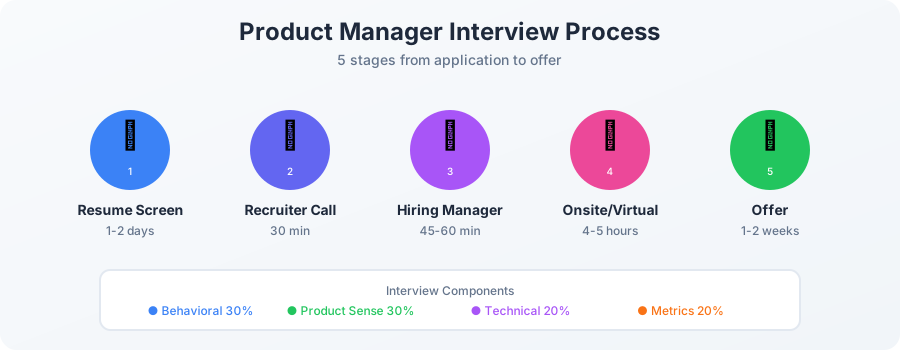
Product Manager Interview Process - 5 Stages
The typical PM interview process from application to offer, including the different types of interviews you'll encounter at each stage.
Resume Screen
1-2 days
Recruiter Call
30 min
Hiring Manager
45-60 min
Onsite/Virtual
4-5 hours
Offer
1-2 weeks
30%
Behavioral
30%
Product Sense
20%
Technical
20%
Metrics/Data
What Makes PM Interviews Different
Product Manager interviews are uniquely challenging because they assess multiple dimensions simultaneously: strategic thinking, analytical skills, communication, leadership, and technical fluency. Unlike engineering interviews with clear right answers, PM interviews evaluate your thinking process, judgment, and ability to navigate ambiguity.
Top companies like Google, Meta, Amazon, and Apple each have distinct interview processes, but they all aim to answer the same question: Can this person ship impactful products? Your job is to demonstrate product sense, customer empathy, data-driven decision making, and the ability to work effectively with cross-functional teams.
This guide covers the complete PM interview process, from recruiter screen to offer negotiation. Whether you're interviewing at FAANG or a Series B startup, these principles will help you prepare effectively and perform confidently.
The PM Interview Process
Most PM interviews follow a similar multi-stage process. Understanding each stage helps you prepare appropriately and manage expectations.
Recruiter Screen
30 minInitial call to assess fit and discuss background
Hiring Manager Screen
45-60 minDeeper dive into experience and role fit
Phone/Video Interviews
45-60 min eachTechnical and product sense assessments
On-site/Virtual Loop
4-6 hoursMultiple interviews covering all competencies
Final Round
VariesExecutive/cross-functional interviews
PM Interview Question Types
PM interviews assess four core competencies. Understanding the weight and approach for each helps you allocate preparation time effectively.
Behavioral
Past experiences and how you handled situations
Example Questions:
- •Tell me about a time you had to influence without authority
- •Describe a product you launched that failed
- •How do you handle disagreements with engineers?
Product Sense
Designing products, features, and solving user problems
Example Questions:
- •Design a product for elderly people to stay connected with family
- •How would you improve Instagram Stories?
- •Build a feature to increase Uber driver retention
Analytical
Metrics, data interpretation, and success measurement
Example Questions:
- •How would you measure success for YouTube Shorts?
- •DAU dropped 10% this week—what do you do?
- •What metrics would you track for a checkout flow?
Technical
Technical concepts, system design, and engineering tradeoffs
Example Questions:
- •How does a recommendation system work?
- •Explain the difference between REST and GraphQL
- •Design a notification system architecture
Interviewing for an AI PM role? AI product manager interviews add model evaluation, LLM product sense, and agentic-AI questions on top of the standard loop. Prepare with our dedicated AI product manager interview questions guide.
Essential PM Interview Frameworks
STAR Method (Behavioral)
Situation
Set the context briefly (2-3 sentences)
Task
Your specific responsibility
Action
What YOU did (most detail here)
Result
Quantifiable impact + learnings
CIRCLES Method (Product Design)
4-Week Interview Preparation Plan
Foundation
- • Research target companies deeply (products, culture, recent news)
- • Write out 5-7 STAR stories covering key competencies
- • Review PM fundamentals (metrics, prioritization, user research)
- • Schedule mock interviews for weeks 2-4
Product Sense
- • Practice product design questions daily (30-45 min each)
- • Learn CIRCLES method and practice applying it
- • Do 2-3 mock interviews focused on product sense
- • Analyze 5 products you use—what would you improve?
Analytical & Technical
- • Practice metrics questions (success metrics, debugging)
- • Review basic SQL and data concepts
- • Study technical fundamentals (APIs, databases, mobile)
- • Do 2-3 mock interviews mixing question types
Polish & Practice
- • Full mock interviews simulating real conditions
- • Refine weak areas based on feedback
- • Prepare questions to ask interviewers
- • Rest before actual interviews—avoid burnout
Common PM Interview Mistakes
Mistakes to Avoid
- -Jumping to solutions without clarifying the problem
- -Giving vague answers without specific examples
- -Not thinking aloud—interviewers can't evaluate silence
- -Talking too long (aim for 2-3 min answers)
- -Not asking clarifying questions
- -Criticizing past colleagues or companies
What Top Candidates Do
- +Start by clarifying scope and constraints
- +Use specific numbers and outcomes in stories
- +Structure answers visibly (frameworks, lists)
- +Check in with interviewer during long answers
- +Show genuine curiosity about the company
- +Own failures and share what they learned
Frequently Asked Questions
How long does the PM interview process take?
The typical PM interview process takes 4-8 weeks from application to offer. This includes recruiter screen (1 week), phone screens (1-2 weeks), on-site interviews (1-2 weeks for scheduling), and decision/offer (1-2 weeks). FAANG companies often take longer (6-10 weeks) due to multiple interview loops and committee reviews. Startups can move faster, sometimes completing the process in 2-3 weeks.
What are the main types of PM interview questions?
PM interviews typically cover four question types: (1) Behavioral questions about past experiences using STAR method, (2) Product sense questions about designing products or features, (3) Analytical/metrics questions about data interpretation and success measurement, and (4) Technical questions about system design, APIs, or technical concepts. Most companies weight behavioral and product sense most heavily.
How should I prepare for a PM interview?
Start preparation 4-6 weeks before interviews. First, research the company and its products deeply. Practice 2-3 behavioral stories using STAR format. Learn product frameworks (CIRCLES, AARRR, Jobs-to-be-Done). Do 10-15 mock interviews with peers or coaches. Study the company's metrics and business model. Review basic SQL and data concepts. Finally, prepare thoughtful questions for interviewers.
Do I need a technical background for PM interviews?
Technical depth requirements vary by company and role. Consumer PM roles typically require basic technical literacy (understanding APIs, databases, mobile vs web). Platform and infrastructure PM roles require stronger technical skills and may include system design interviews. You don't need to code, but you should be able to have informed discussions with engineers about technical tradeoffs.
What frameworks should I know for PM interviews?
Key frameworks include: CIRCLES method for product design questions, STAR method for behavioral questions, AARRR (pirate metrics) for growth questions, Root cause analysis for debugging questions, and prioritization frameworks (RICE, MoSCoW) for strategy questions. Don't memorize frameworks rigidly—understand the principles and adapt them naturally to each question.
How important are mock interviews?
Mock interviews are essential. Studies show candidates who do 10+ mock interviews have significantly higher success rates. Mock interviews help you practice thinking aloud, get feedback on blind spots, reduce anxiety, and improve time management. Use a mix of peer practice (free) and professional coaching (paid) for best results. Record yourself to identify verbal tics and areas for improvement.
What should I do if I don't know the answer to a question?
Never pretend to know something you don't. Instead: (1) Acknowledge what you don't know specifically, (2) Share your thought process for how you would find the answer, (3) Make reasonable assumptions and state them clearly, (4) Apply relevant frameworks even without perfect information. Interviewers value intellectual honesty and structured thinking over perfect answers.
How do PM interviews differ between companies?
Each company has distinct focuses: Google emphasizes analytical thinking and data-driven decisions. Amazon focuses on Leadership Principles and customer obsession. Meta prioritizes product sense and execution. Apple values design thinking and attention to detail. Microsoft emphasizes collaboration and technical depth. Startups often focus on scrappiness and ownership. Research each company's specific interview process and values.
Watch: PM Career Insights
About the Author

Aditi Chaturvedi
·Founder, Best PM JobsAditi is the founder of Best PM Jobs, helping product managers find their dream roles at top tech companies. With experience in product management and recruiting, she creates resources to help PMs level up their careers.