
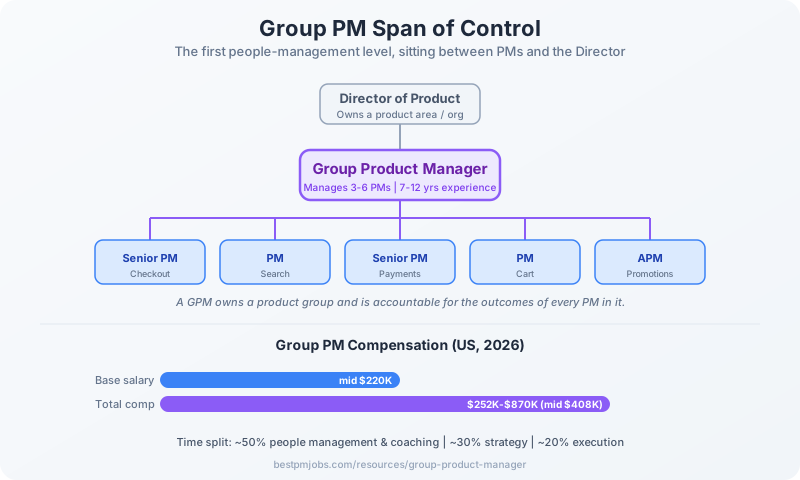
Group PM Span of Control
The GPM manages 3 to 6 PMs and is accountable for the outcomes of the whole group.
What does a Group Product Manager do?
A Group Product Manager leads a team of PMs and owns the strategy for a product group. Unlike a Senior PM, the GPM delivers results through other people. Core responsibilities are listed below.
Manage and coach PMs
Run one-on-ones, give feedback, support career growth, and raise the product craft of 3 to 6 PMs.
Own group-level strategy
Set the strategy and roadmap for the product group, ensuring every PM area ladders up to a coherent plan.
Be accountable for group outcomes
Carry responsibility for the metrics and results of every PM in the group, not just your own work.
Hire and shape the team
Interview, hire, and onboard PMs; decide how to structure the group as it grows.
Coordinate across teams
Align the group with engineering, design, and adjacent product groups on shared priorities.
Unblock and prioritize
Remove obstacles for the team and make prioritization calls when PMs face competing demands.
Looking for PM jobs? Browse opportunities on bestpmjobs.com →
Group PM vs Senior PM and Director
The Group Product Manager sits between two well-known roles. The tables below compare it with the Senior Product Manager below it and the Director of Product Management above it.
Group Product Manager vs Senior Product Manager
| Aspect | Group Product Manager | Senior Product Manager |
|---|---|---|
| Track | Management (manages PMs) | Individual contributor |
| Scope | A product group of 3–6 PMs | A single product area |
| Delivers through | A team | Own work |
| Years experience | 7–12 years | 5–8 years |
| Total comp (mid) | $408K | $290K |
Group Product Manager vs Director of Product
| Aspect | Group Product Manager | Director of Product |
|---|---|---|
| Span | Manages 3–6 PMs directly | Manages a larger org, often including GPMs |
| Hands-on product work | Still close to the product | More removed; org-level focus |
| Primary focus | Group strategy and coaching | Org design, hiring strategy, alignment |
| Reports to | Director or Head of Product | Head of Product, VP, or CPO |
| Total comp (mid) | $408K | $552K |
Required Skills & Qualifications
The GPM role demands a shift from product craft to people leadership. Most GPMs have 7 to 12 years of product experience and a proven track record of mentoring other PMs.
People management
Coaching, feedback, performance management, and growing PMs across levels.
Strategic thinking
Setting a coherent strategy across multiple product areas, not just one.
Hiring & interviewing
Recruiting strong PMs and building a high-performing, well-structured team.
Stakeholder management
Aligning engineering, design, and leadership around the direction of the group.
Prioritization at scale
Allocating capacity and making trade-offs across several workstreams at once.
Influence and communication
Driving outcomes across teams without direct authority over all of them.
The hardest shift is delivering through others
Salary & Compensation
In the United States in 2026, a Group Product Manager earns a median base salary of $220,000. Total compensation (base plus equity plus bonus) ranges from $252,000 to $870,000, with a national midpoint of $408,000. This matches the Staff Product Manager band, since both roles represent the same level on the management and IC tracks respectively.
| Component | Low | Mid | High |
|---|---|---|---|
| Base salary | $185K | $220K | $270K |
| Total compensation | $252K | $408K | $870K |
For the full breakdown by location and company, see the Group PM salary guide. The Staff PM role pays similarly on the individual contributor track.
Ready for a Group Product Manager role?
Browse product leadership openings on Best PM Jobs.
Find PM Jobs3,591+ active PM roles · $150K+ average salary
How to Become a Group Product Manager
Becoming a GPM is about demonstrating leadership before you have the title. Follow these five steps.
Excel as a Senior PM
Consistently ship products that move metrics and earn a reputation as one of the strongest PMs on the team.
Start mentoring other PMs
Coach APMs and PMs informally, lead onboarding, and demonstrate that you can grow others, not just yourself.
Own cross-team strategy
Take on initiatives that span multiple PM areas so you build the strategic muscle a GPM needs.
Make the case for management
Signal to your manager that you want the people-management track and take on stretch leadership responsibilities.
Step into the GPM role
Move into a Group PM position, internally via promotion or externally, and focus first on building trust with your new reports.
A Day in the Life
A representative day for a Group Product Manager:
- 9:00 Review group metrics and check in on each PM's top priority.
- 10:00 One-on-ones with two PMs on roadmap and career growth.
- 12:00 Group strategy review to align the team's roadmaps.
- 14:00 Interview a PM candidate and debrief with the panel.
- 15:30 Unblock a PM facing a cross-team dependency.
- 16:30 Sync with the Director on group priorities and headcount.
Frequently Asked Questions
What is a Group Product Manager?
A Group Product Manager (GPM) is a product leader who manages a group of 3 to 6 product managers while remaining accountable for the strategy and outcomes of a product area. The GPM role is typically the first people-management level on the product career ladder, sitting between Senior Product Manager and Director of Product. A GPM splits time roughly between managing and coaching PMs (about half), setting strategy (about a third), and hands-on execution (the remainder).
How much does a Group Product Manager make?
In the United States in 2026, a Group Product Manager earns a median base salary of $220,000. Total compensation (base plus equity plus bonus) ranges from $252,000 to $870,000, with a national midpoint of $408,000. Equity grows as a share of pay at this level, and total compensation is similar to a Staff Product Manager, who reaches the same scope on the individual contributor track.
Is Group Product Manager a promotion from Senior PM?
Yes. Group Product Manager is generally one level above Senior Product Manager and represents a shift from individual contribution to people management. A Senior PM owns a product area and ships through their own work; a GPM owns a larger group and delivers through a team of PMs. The promotion requires demonstrated leadership, mentorship, and the ability to set strategy across multiple workstreams rather than one.
What is the difference between a Group PM and a Director of Product?
A Group Product Manager manages 3 to 6 PMs and stays close to the product, often still owning some direct product decisions. A Director of Product manages a larger organization (frequently including GPMs and Senior PMs), owns a broader area, and operates at a higher level of abstraction focused on org design, hiring strategy, and cross-team alignment. The GPM is hands-on; the Director is more removed from day-to-day product work. Director total compensation midpoint is $552,000 versus $408,000 for a GPM.
How many PMs does a Group Product Manager manage?
A Group Product Manager typically manages 3 to 6 product managers, which can include a mix of Associate PMs, PMs, and Senior PMs. The exact number depends on company size and how product teams are organized. Beyond about 6 reports, the role usually splits or the person is promoted to Director to keep the span of control manageable.
How long does it take to become a Group Product Manager?
Most Group Product Managers have 7 to 12 years of product experience. The path runs through Associate PM or PM, then Senior PM, before stepping into the GPM role. The transition depends less on tenure and more on demonstrated leadership: mentoring other PMs, owning cross-team strategy, and showing you can deliver results through others rather than only through your own work.
Should I choose the Group PM or Staff PM track?
Choose Group PM if you want to manage people, coach a team, and grow PMs; choose Staff PM if you prefer to stay an individual contributor and lead through influence and deep product work rather than headcount. The two tracks pay similarly (both around $408,000 midpoint total compensation) and represent the management and IC forks of the product career ladder at the same level.
About the Author

Aditi Chaturvedi
·Founder, Best PM JobsAditi is the founder of Best PM Jobs, helping product managers find their dream roles at top tech companies. With experience in product management and recruiting, she creates resources to help PMs level up their careers.