
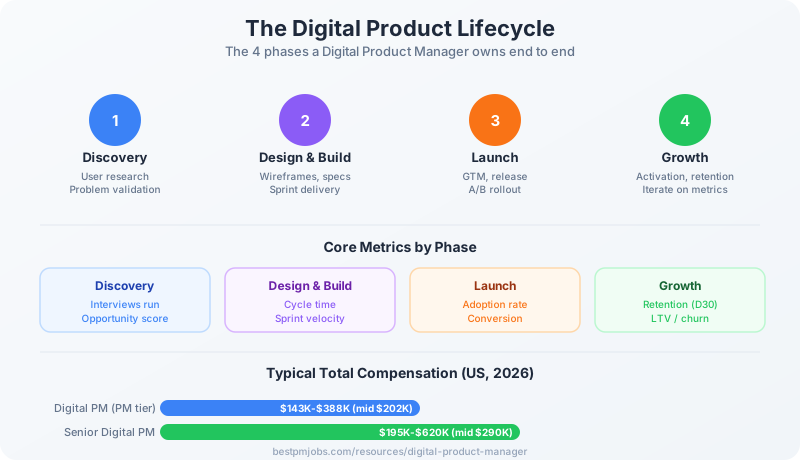
The Digital Product Lifecycle
A Digital Product Manager owns all four phases end to end, from discovery to growth.
What does a Digital Product Manager do?
A Digital Product Manager decides what digital product to build, then leads the team that builds it. The role spans research, planning, delivery, and growth. Core responsibilities are listed below.
Run discovery and research
Interview users, analyze behavior, and validate which problems are worth solving before any code is written.
Define the roadmap
Prioritize features and initiatives that move the product toward its goals and communicate the plan to stakeholders.
Write specs and user stories
Translate problems into clear requirements that engineering and design can build against.
Drive sprint delivery
Partner with engineers and designers daily, unblock the team, and keep work flowing through each sprint.
Own launch and go-to-market
Coordinate releases, A/B rollouts, and launch communications with marketing and support teams.
Grow the product
Track activation, conversion, and retention; run experiments to improve the metrics that matter.
Looking for PM jobs? Browse opportunities on bestpmjobs.com →
The Digital Product Lifecycle
The Digital Product Manager owns four phases. Each phase has a distinct focus, set of activities, and primary metric.
| Phase | Focus | Activities | Primary metric |
|---|---|---|---|
| 1. Discovery | Understand the problem | User interviews, surveys, opportunity sizing, problem validation | Interviews run, opportunity score |
| 2. Design & Build | Create the solution | Wireframes, specs, prototypes, sprint delivery with engineering | Cycle time, sprint velocity |
| 3. Launch | Ship to market | Go-to-market plan, phased release, A/B rollout, launch comms | Adoption rate, conversion |
| 4. Growth | Improve outcomes | Experimentation, funnel optimization, retention work, iteration | Retention (D30), LTV, churn |
Use a strategy framework to choose what to build
Digital PM vs Product Manager & Product Marketing Manager
The Digital Product Manager title is frequently confused with the general Product Manager and the Product Marketing Manager. The tables below clarify the differences.
Digital Product Manager vs Product Manager
| Aspect | Digital Product Manager | Product Manager |
|---|---|---|
| Product type | Explicitly digital (app, web, SaaS) | Any product (often digital by default) |
| Common industries | Retail, banking, media, manufacturing | Tech and software companies |
| Core responsibilities | Same: discovery, roadmap, delivery, growth | Same: discovery, roadmap, delivery, growth |
| Skills required | Identical | Identical |
| Total comp (mid) | $202K | $202K |
Digital Product Manager vs Product Marketing Manager
| Aspect | Digital Product Manager | Product Marketing Manager |
|---|---|---|
| Owns | The product and what gets built | Positioning, messaging, and launch |
| Works with | Engineering and design (inward) | Sales and marketing (outward) |
| Key question | What should we build? | How do we take it to market? |
| Primary metrics | Adoption, conversion, retention | Positioning, demand, win rate |
| Total comp (mid) | $202K | ~$180K |
Required Skills & Qualifications
Digital product management rewards a mix of user empathy and analytical thinking. Most roles ask for 2 to 8 years of relevant experience; a specific degree is rarely required.
User research & discovery
Running interviews and synthesizing insights to find problems worth solving.
Data & experimentation
Analytics, funnels, and A/B testing to validate decisions with evidence.
UX collaboration
Working closely with designers on flows, usability, and interface decisions.
Agile delivery
Backlog management, sprint planning, and shipping iteratively with engineering.
Prioritization
Using frameworks like RICE to decide what to build next under constraints.
Stakeholder communication
Aligning marketing, sales, support, and leadership around the roadmap.
Salary & Compensation
In the United States in 2026, a Digital Product Manager earns a median base salary of about $140,000. Total compensation (base plus equity plus bonus) ranges from $143,000 to $388,000, with a national midpoint near $202,000. A Senior Digital Product Manager earns a midpoint total compensation around $290,000. Pay matches the standard Product Manager bands because the roles are equivalent.
| Level | Base (mid) | Total comp range | Total (mid) |
|---|---|---|---|
| Digital PM | $140K | $143K–$388K | $202K |
| Senior Digital PM | $175K | $195K–$620K | $290K |
For a full breakdown by level and location, see the PM salary guide, and review how pay scales with seniority in PM career levels.
Looking for a Digital Product Manager role?
Browse digital and SaaS product roles on Best PM Jobs.
Find PM Jobs3,591+ active PM roles · $150K+ average salary
How to Become a Digital Product Manager
There is no single path into digital product management. The five steps below work for career changers and early professionals alike.
Build digital product fundamentals
Learn the lifecycle: discovery, design, launch, and growth. Study how successful apps and SaaS products are built and measured.
Develop a core skill to enter from
Strengthen one adjacent skill such as UX, analytics, engineering, or marketing that gives you a foothold into product work.
Ship something real
Build a side project, lead a digital initiative at your current job, or run an experiment end to end. A shipped digital product is the strongest portfolio piece.
Learn the tools and frameworks
Get comfortable with analytics tools, A/B testing, prioritization frameworks, and agile workflows used in modern product teams.
Apply and interview as a PM
Target Associate or mid-level digital product manager roles. Prepare product sense, analytical, and execution interview questions.
A Day in the Life
A representative day for a Digital Product Manager:
- 9:00 Check overnight metrics and the status of a running A/B test.
- 9:30 Daily standup with engineering and design.
- 10:30 User interviews to validate the next feature in discovery.
- 13:00 Write specs and refine the backlog for the upcoming sprint.
- 15:00 Review designs with the design team and give feedback.
- 16:00 Sync with marketing on the launch plan for a new feature.
Frequently Asked Questions
What is a Digital Product Manager?
A Digital Product Manager is a product manager who owns digital products such as mobile apps, websites, and SaaS platforms from discovery through growth. The role is responsible for understanding user needs, defining the roadmap, working with engineering and design to ship features, and improving metrics like conversion and retention. The "digital" qualifier signals that the product itself is software delivered through a digital channel, as opposed to a physical or services product.
Is a Digital Product Manager the same as a Product Manager?
Largely yes. In most tech companies, "Product Manager" already implies digital products, so the two titles are used interchangeably. The "Digital Product Manager" title appears most often in industries that also build physical products or run traditional channels, such as retail, banking, media, and manufacturing, where the company needs to distinguish the person who owns the app or website from those who manage physical goods. The core responsibilities, skills, and salary are essentially identical to a general Product Manager.
How much does a Digital Product Manager make?
In the United States in 2026, a Digital Product Manager earns a median base salary of about $140,000, with total compensation (base plus equity plus bonus) ranging from $143,000 to $388,000 and a national midpoint near $202,000. A Senior Digital Product Manager earns a midpoint total compensation around $290,000. Pay matches the standard Product Manager bands because the roles are equivalent.
What does a Digital Product Manager do day to day?
A Digital Product Manager runs user research and discovery, writes product specs and user stories, prioritizes the backlog, works daily with engineers and designers in sprints, reviews analytics and experiment results, and coordinates launches with marketing. The role moves across the full digital product lifecycle: discovery, design and build, launch, and growth.
What skills does a Digital Product Manager need?
Key skills include user research and discovery, data analysis and experimentation, UX and design collaboration, agile delivery, roadmap prioritization, and stakeholder communication. Familiarity with analytics tools (such as Amplitude or Mixpanel), A/B testing, and basic technical literacy to work with engineers are also important. Strong digital product managers pair quantitative rigor with empathy for the user.
How do you become a Digital Product Manager?
Common paths include transitioning from UX design, engineering, marketing, or business analysis; starting as an Associate Product Manager; or moving from a digital-adjacent role like growth or analytics. Building a portfolio that shows you have shipped a digital product and improved a metric is the strongest signal. Many digital product managers come from non-traditional backgrounds because the role rewards user empathy and analytical thinking over a specific degree.
What is the difference between a Digital Product Manager and a Product Marketing Manager?
A Digital Product Manager decides what to build and owns the product itself; a Product Marketing Manager decides how to position, message, and launch it to the market. The Digital Product Manager works inward with engineering and design on the roadmap, while the Product Marketing Manager works outward with sales and marketing on go-to-market. The two collaborate closely at launch but own different outcomes: the product manager owns adoption and retention, the marketer owns positioning and demand.
About the Author

Aditi Chaturvedi
·Founder, Best PM JobsAditi is the founder of Best PM Jobs, helping product managers find their dream roles at top tech companies. With experience in product management and recruiting, she creates resources to help PMs level up their careers.