
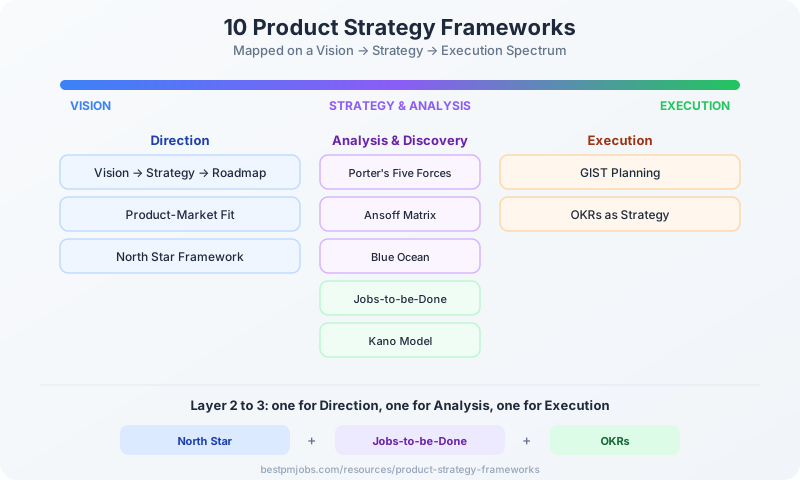
The 10 Frameworks on a Vision → Strategy → Execution Spectrum
Direction frameworks sit near vision, analysis and discovery in the middle, and execution frameworks near delivery.
Strong product strategy is mostly a sequence of explicit choices. The frameworks below are tools for making those choices in the open, where the rest of the team can question them. Each one answers a different question, so they are most useful when layered rather than used in isolation. The spectrum runs from frameworks that set direction, through frameworks that analyze markets and discover needs, to frameworks that drive execution.
Looking for PM jobs? Browse opportunities on bestpmjobs.com →
The 10 Frameworks
Vision → Strategy → Roadmap
What it is
A top-down cascade that turns a long-term product vision into a strategy (the few choices about where to compete) and then into a sequenced roadmap of initiatives. It keeps daily work traceable to a clear destination.
When to use it
Use when the team feels busy but directionless, or when a roadmap exists with no stated reason behind its order. It is the default backbone most other frameworks plug into.
Steps
- Write a vision statement describing the future state you want to create for a specific customer.
- Define strategy: name the target segment, the value proposition, and the 3 to 5 bets that win.
- Translate each bet into roadmap initiatives with rough sequencing and success measures.
- Review quarterly: confirm the roadmap still serves the strategy and the strategy still serves the vision.
Example
A collaboration tool sets a vision of "every team plans in one place," picks a strategy of winning mid-market teams through integrations, and sequences a roadmap that ships the top 5 integrations first.
Product-Market Fit
What it is
A framework for confirming that a specific customer segment has a strong, repeatable need for your product. Product-market fit is the precondition for scaling: spending on growth before fit usually wastes capital.
When to use it
Use at the early stage of a product or a new market entry, before investing heavily in growth or large roadmap bets.
Steps
- Pick one narrow customer segment and define the urgent problem you solve for it.
- Ship the smallest version that solves that problem end to end.
- Measure retention and the Sean Ellis survey question: the share who would be very disappointed without the product.
- Iterate until at least 40 percent answer "very disappointed" and retention curves flatten.
Example
A scheduling app narrows from "everyone" to "solo consultants," reaches 45 percent very-disappointed and flat 8-week retention, then expands to adjacent segments.
North Star Framework
What it is
A model that picks one North Star Metric capturing the core value customers get, then identifies the input metrics teams can move to grow it. It aligns multiple teams on a single measure of progress.
When to use it
Use once you have product-market fit and need cross-team alignment on what "progress" means during scaling.
Steps
- Identify the moment customers receive core value (the value exchange).
- Choose one North Star Metric that quantifies that value over time.
- Map 3 to 5 input metrics that teams can directly influence to move the North Star.
- Assign teams to inputs and review the chain weekly.
Example
A streaming service sets "weekly time streamed" as its North Star, with inputs of new-title additions, recommendation accuracy, and playback reliability.
Porter's Five Forces
What it is
A market-structure analysis that scores five forces shaping profitability: rivalry, new entrants, substitutes, supplier power, and buyer power. It tells you whether a market is structurally attractive before you commit.
When to use it
Use when evaluating entry into a new market or category, or when deciding how defensible an existing position is.
Steps
- Score competitive rivalry: how many capable competitors and how intense the price competition.
- Score threat of new entrants and the height of barriers to entry.
- Score threat of substitutes that solve the same job differently.
- Score supplier and buyer bargaining power, then judge overall attractiveness.
Example
A payments startup finds high buyer power and many substitutes, so it narrows to an underserved vertical where switching costs are higher.
Ansoff Matrix
What it is
A 2x2 that classifies growth bets by market (existing or new) and product (existing or new): penetration, market development, product development, and diversification. Each quadrant carries a different risk level.
When to use it
Use during annual planning to balance a portfolio of growth bets across risk levels rather than crowding into one quadrant.
Steps
- List candidate growth bets for the planning period.
- Place each bet in one of the four quadrants by market and product novelty.
- Note the risk: penetration is lowest, diversification is highest.
- Balance the portfolio so most capacity sits in lower-risk quadrants with a few high-upside bets.
Example
A SaaS company funds penetration (more seats in current accounts) heavily, product development (a new module) moderately, and one diversification bet lightly.
Blue Ocean Strategy
What it is
A framework for creating uncontested market space by changing the factors an industry competes on. Its Eliminate-Reduce-Raise-Create grid redesigns the value curve instead of out-spending rivals on existing attributes.
When to use it
Use when a market is crowded and competing on the same attributes yields shrinking margins.
Steps
- Map the current value curve: the attributes the industry competes on and how players score.
- Apply the grid: which attributes to eliminate, reduce, raise, and create.
- Design a new value curve that diverges sharply from rivals.
- Validate that the new offering attracts non-customers, not just current buyers.
Example
A budget airline eliminates assigned seating and meals, reduces lounges, raises frequency, and creates simple flat pricing to reach price-sensitive non-flyers.
Jobs-to-be-Done
What it is
A lens that defines demand by the progress a customer is trying to make in a situation, rather than by demographics or features. It surfaces the real competition (any alternative that does the job).
When to use it
Use during discovery to find unmet needs and to frame what your product is really hired to do.
Steps
- Interview customers about the situation that triggered them to look for a solution.
- Write the job as a statement: when [situation], I want to [motivation], so I can [outcome].
- List the functional, emotional, and social dimensions of the job.
- Identify where current solutions underserve the job and target those gaps.
Example
A milkshake is "hired" for a boring morning commute, so the company makes it thicker to last longer rather than competing on dessert flavor.
GIST Planning
What it is
A lightweight planning model with four layers: Goals, Ideas, Step-projects, and Tasks. It replaces rigid long-term roadmaps with a continuously updated set of bets tied to goals.
When to use it
Use when a fixed roadmap keeps going stale and the team wants to plan with more agility while staying goal-driven.
Steps
- Set Goals as measurable objectives over a defined horizon.
- Collect Ideas: many candidate ways to reach the goals, kept in a prioritized bank.
- Run Step-projects: small, time-boxed experiments to test the best ideas.
- Break funded step-projects into Tasks and execute, then re-rank ideas with what you learned.
Example
A growth team sets a 90-day activation goal, maintains 30 ranked ideas, and ships two 2-week step-projects per cycle to test the top ideas.
Kano Model
What it is
A model that classifies features by how they affect satisfaction: basic (expected), performance (more is better), and delighters (unexpected value). It prevents over-investing in features that no longer move satisfaction.
When to use it
Use when deciding which features to fund, especially to balance table-stakes work against differentiators.
Steps
- Survey customers with the functional and dysfunctional question pair for each candidate feature.
- Classify each feature as basic, performance, delighter, or indifferent.
- Fund all basics first, then a strong set of performance features, then a few delighters.
- Re-survey over time, because today's delighters become tomorrow's basics.
Example
A phone maker treats battery life as a performance feature, water resistance as a delighter, and a working dialer as a basic must-have.
OKRs as Strategy
What it is
Objectives and Key Results used to translate a chosen strategy into measurable quarterly outcomes. Objectives state the qualitative goal; key results quantify success. OKRs operationalize strategy rather than replace it.
When to use it
Use after you have chosen a direction, to align teams on measurable outcomes and track progress quarter by quarter.
Steps
- Confirm the strategy and the few bets it implies for the quarter.
- Write 3 to 5 objectives that match those bets.
- Add 2 to 4 measurable key results per objective with baselines and targets.
- Review weekly, score quarterly, and feed learning into the next cycle.
Example
A team executing an enterprise strategy sets an objective to "win mid-market trust" with key results on enterprise NPS, security certifications shipped, and reference customers added.
Put These Frameworks to Work
Product roles that own strategy are in demand. Browse open PM positions at top companies.
Find PM Jobs3,591+ active PM roles · $150K+ average salary
Master Comparison Table
| Framework | Best for | Output | Horizon |
|---|---|---|---|
| Vision → Strategy → Roadmap | Aligning daily work to a destination | Cascade from vision to initiatives | 1 to 3 years |
| Product-Market Fit | Confirming a real, repeatable need | Evidence of fit (retention, survey) | 3 to 12 months |
| North Star Framework | Cross-team alignment on growth | One metric plus input metrics | 6 to 18 months |
| Porter's Five Forces | Judging market attractiveness | Five-force attractiveness score | 1 to 3 years |
| Ansoff Matrix | Balancing growth-bet risk | Bets classified by risk quadrant | 1 to 2 years |
| Blue Ocean | Escaping a crowded market | New value curve | 2 to 4 years |
| Jobs-to-be-Done | Finding unmet needs | Job statements and gaps | Ongoing discovery |
| GIST Planning | Agile, goal-driven planning | Goals, ideas, step-projects | 1 to 4 quarters |
| Kano Model | Choosing which features to fund | Features classified by satisfaction | 1 to 2 quarters |
| OKRs as Strategy | Making strategy measurable | Objectives and key results | 1 quarter |
How to Choose a Framework
Work down this decision tree in order and stop at the first match. The question you are trying to answer determines the framework, not the other way around.
Do you have evidence customers urgently need the product?
Is the team aligned on one measure of progress?
Are you considering a new market or category?
Is the market crowded with shrinking margins?
Do you understand what customers are really trying to do?
Are there too many feature requests to fund?
Is the strategy set but progress fuzzy?
Layer, do not stack endlessly
How to Build a Product Strategy
Set the vision
Describe the future state you want to create for a specific customer in one or two sentences.
Analyze the market and customer
Use Jobs-to-be-Done to find unmet needs and Porter's Five Forces to judge market attractiveness.
Make the strategic choices
Name the target segment, the value proposition, and the 3 to 5 bets that will win.
Choose a focusing metric
Set a North Star Metric and the input metrics teams can move to grow it.
Prioritize the bets
Apply RICE or the Kano Model to decide which initiatives to fund first.
Operationalize with OKRs
Write objectives that match the bets and key results that measure the predicted outcomes.
Review and adapt
Reassess the full strategy once or twice a year and adjust the roadmap each quarter.
For prioritization in steps 5 and 6, the RICE framework, Kano Model, and OKRs guide give you concrete scoring methods. To capture the result, start from a product strategy template.
Use-Case Cheat Sheet
| Scenario | Recommended framework | Why |
|---|---|---|
| New product with no validated customers | Product-Market Fit | Confirm a real, urgent need before scaling spend. |
| Roadmap exists but nobody knows why | Vision → Strategy → Roadmap | Re-anchor each initiative to a stated bet and vision. |
| Five teams chasing different metrics | North Star Framework | Unite teams on one value metric and its inputs. |
| Considering entry into a new category | Porter's Five Forces | Test whether the market is structurally attractive. |
| Annual planning with mixed-risk bets | Ansoff Matrix | Balance the portfolio across risk quadrants. |
| Crowded market with shrinking margins | Blue Ocean | Redesign what you compete on to reach non-customers. |
| Unsure what customers really want | Jobs-to-be-Done | Define demand by the progress customers seek. |
| Fixed roadmaps keep going stale | GIST Planning | Plan in goals, ideas, and short experiments. |
| Too many feature requests to fund | Kano Model | Separate table stakes from delighters. |
| Strategy is set but progress is fuzzy | OKRs as Strategy | Translate the strategy into measurable outcomes. |
Frequently Asked Questions
What is a product strategy framework?
A product strategy framework is a repeatable structure that helps a product team decide which problems to solve, for whom, and in what order. It connects a long-term vision to near-term execution by forcing explicit choices about target customers, value proposition, and prioritization. Frameworks reduce guesswork and make strategy reviewable: instead of one person's opinion, the team evaluates options against a shared set of criteria.
How many product strategy frameworks should a team use at once?
Most teams use 2 to 3 frameworks at a time, layered by purpose. A common stack is one framework for direction (Vision-Strategy-Roadmap or North Star), one for opportunity analysis (Jobs-to-be-Done or Porter's Five Forces), and one for prioritization (RICE or OKRs). Using more than 3 at once tends to create overhead without improving decisions, because the frameworks start to overlap.
Which product strategy framework is best for a startup?
For an early-stage startup, Product-Market Fit and Jobs-to-be-Done are the most useful starting points because they focus on finding a customer segment with an urgent need. Once you have evidence of fit, add the North Star Framework to align the team on one growth metric. Heavier analytical frameworks such as Porter's Five Forces add more value after you have a defensible position to protect.
What is the difference between product strategy and a product roadmap?
Product strategy is the set of choices about where you will compete and how you will win: target customers, value proposition, and the few bets that matter. A product roadmap is the time-sequenced plan of initiatives that execute that strategy. Strategy answers "why these bets"; the roadmap answers "what we build and roughly when." Strategy should change rarely; the roadmap can adjust every quarter.
Are Porter's Five Forces and the Ansoff Matrix still relevant for software?
Yes. Porter's Five Forces is useful for assessing whether a market is structurally attractive (supplier power, buyer power, substitutes, new entrants, rivalry) before you commit roadmap capacity to it. The Ansoff Matrix helps you classify growth bets as market penetration, market development, product development, or diversification, each carrying a different risk profile. Both frameworks predate software but map cleanly onto platform and SaaS decisions.
How do OKRs fit with strategy frameworks?
OKRs (Objectives and Key Results) translate a chosen strategy into measurable quarterly targets. They are not a strategy on their own: if you set OKRs without first choosing where to compete, you get well-measured movement in an unclear direction. Use a direction-setting framework first, then write OKRs whose objectives match the strategy and whose key results measure the outcomes that strategy predicts.
Can you combine Blue Ocean and Jobs-to-be-Done?
Yes, and they pair well. Jobs-to-be-Done identifies the underlying progress a customer is trying to make, which often reveals needs current products serve poorly. Blue Ocean Strategy then helps you design an offering that eliminates and reduces low-value attributes while raising and creating high-value ones. Used together, JTBD finds the opportunity and Blue Ocean shapes the differentiated response.
How often should product strategy be revisited?
Revisit the full strategy once or twice a year, and pressure-test it whenever a major assumption changes, such as a new competitor, a shift in customer behavior, or a missed growth target for two consecutive quarters. The roadmap that executes the strategy is reviewed more often, typically every quarter. Avoid rewriting strategy monthly: frequent reversals confuse the team and prevent any single bet from being tested fairly.
About the Author

Aditi Chaturvedi
·Founder, Best PM JobsAditi is the founder of Best PM Jobs, helping product managers find their dream roles at top tech companies. With experience in product management and recruiting, she creates resources to help PMs level up their careers.